
Traditional vs. Civil Wedding Ceremony: What’s the Difference?
Planning your ceremony style can feel confusing. Here’s a clear, neutral breakdown of traditional (religious) and civil wedding ceremony who can officiate, where they’re held, what’s typically included, and how the legal paperwork works, so you can choose what fits you.
Quick Definitions
Traditional (religious) ceremony: Led by clergy within a faith tradition (or at your venue with clergy), includes prayers/readings/rituals, and is sacred within that faith. It also includes the civil/legal portion, so your marriage is recognized by the state.
Civil ceremony: Non-religious; led by a judge, magistrate, clerk, or authorized celebrant. It focuses on your vows and the legal act of marriage. You can add meaningful readings, unity rituals, or cultural elements—just no required religious content.
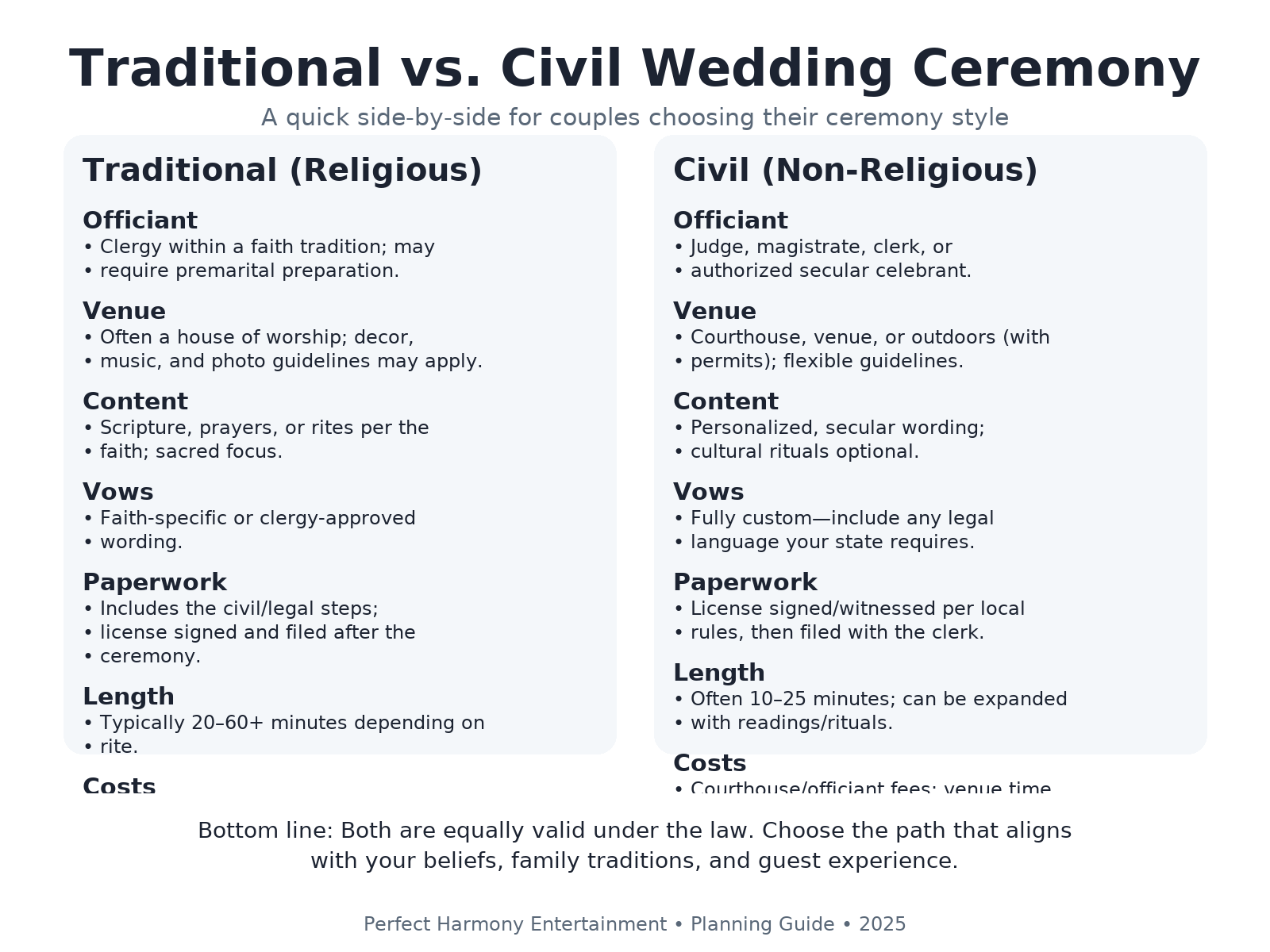
Key Differences at a Glance
Officiant: Clergy vs. judge/magistrate/authorized celebrant.
Venue rules: Houses of worship often have decor, music, and photography guidelines; civil ceremonies are flexible (courthouse, venue, outdoors with permits).
Content: Religious scriptures/rites vs. personalized secular wording (you can still include readings/rituals in a civil ceremony).
Vows: Faith-specific or clergy-approved vs. fully custom (within legal wording).
Prep/requirements: Some faiths ask for classes or counseling; civil usually doesn’t.
Paperwork: Both require a valid marriage license; witnessing rules and filing deadlines vary by state/county (ask your clerk).
Length: Religious 20–60+ minutes; civil 10–25 minutes (typical ranges).
Costs: Donations/fees to the church/synagogue/temple vs. courthouse/officiant fees; venue/time-of-day also affects price.
Bottom line: Both are equally valid under the law. Choose the path that aligns with your beliefs, family traditions, and guest experience.
Popular Middle-Ground Options
An Interfaith ceremony led by clergy from two traditions.
Spiritual but not religious wording with a secular celebrant.
Civil ceremony + religious blessing on another day (or vice-versa).
Cultural rituals (e.g., handfasting, lasso, tea, glass-breaking) added to either format.
Simple Ceremony Outlines
Traditional (example): Processional → Welcome/Prayer → Readings/Homily → Vows & Rings → Blessing → Pronouncement → Recessional.
Civil (example): Processional → Welcome/Your Story → Optional Reading → Vows & Rings → Optional Unity Ritual → Pronouncement → Recessional.
FAQs
-
A civil wedding is a non-religious marriage ceremony performed by a legal officiant such as a judge, magistrate, or licensed officiant. The ceremony focuses on the legal union rather than religious traditions.
-
Not always. Many civil weddings happen at courthouses, but couples can also hold civil ceremonies at venues, outdoor locations, or private event spaces.
-
Yes. Many couples choose a civil ceremony followed by a full reception with dinner, dancing, and entertainment.
-
No—both are fully legal. A traditional ceremony is also sacramental/sacred within its faith.
-
Often yes, but confirm with your clergy—some faiths use set vows or require pre-approval.
-
Depends on your state/county (judge, magistrate, clerk, or authorized celebrant). Ask your local clerk for the current rules.
-
Some jurisdictions require one or two; others don’t. Your clerk will confirm what’s required and who can sign.
-
Yes—keep it non-denominational if you want it fully secular, or blend cultural elements meaningful to you.
-
Check your county clerk for license windows, ID requirements, fees, and filing deadlines. Put those dates on your timeline early.
Planning a Wedding Ceremony and Reception?
If you're planning a civil wedding ceremony and want a reception that keeps guests engaged and the timeline running smoothly, an experienced DJ/MC can make a huge difference.
At Perfect Harmony Entertainment, we help couples coordinate ceremony audio, reception flow, and music that keeps the dance floor full.